Convex Quadratics III: Lower Bounds for First-Order and Stochastic Algorithms
Lecture notes on convex quadratics: Part I (§1–6) · Part II (§7–8) · Part III (§9) · Part IV (§10)
This is Part III of the lecture notes on optimization algorithms for convex quadratics. The problem setup and notation are introduced in Part I.
Contents
9. Lower Bounds for First-Order and Stochastic Algorithms
This section establishes that the upper bounds developed in Sections 2–4 and Section 8 are sharp, by exhibiting matching lower bounds in two settings of interest. The first is the deterministic optimization setting of Sections 2–4: we close the loophole left by the polynomial/Krylov framework, which only constrains methods whose iterates lie in $w_0 + \mathcal{K}_k(H,r_0)$, and show that even algorithms allowed to query gradients at arbitrary points cannot beat the Chebyshev/CG rate $O(\sqrt{\kappa}\,\log(1/\varepsilon))$. The hard instance is the tridiagonal chain quadratic of Nemirovski and Yudin [NY83]. The second is the stochastic estimation setting of Section 8: we show that on the well-specified additive-Gaussian-noise least-squares problem, no algorithm processing $T$ samples can extract excess risk smaller than $\sigma^2 d/(2T)$, matching tail-averaged streaming SGD up to an absolute constant. The argument is the elegant Bayesian-Gaussian-prior proof of Mourtada [Mou22].
For the first setting, we restrict to deterministic first-order algorithms, by which we mean a procedure $\mathcal{A}$ producing iterates $w_0, w_1, \ldots \in \mathbb{R}^d$ in which $w_0$ is a fixed deterministic vector — depending on the problem only through known parameters— and $w_{t+1}$ is a fixed deterministic function of the past gradients $g_0 = \nabla f(w_0), \ldots, g_t = \nabla f(w_t)$. This includes gradient descent with any sequence of stepsizes, conjugate gradients, and indeed any reasonable first-order method.
Zero-chain quadratics
Write $E_m := \operatorname{span}\lbrace e_1,\dots,e_m\rbrace$ for the span of the first $m$ standard basis vectors of $\mathbb{R}^d$, with the convention $E_0 := \lbrace 0\rbrace$. The structural feature that drives the entire lower-bound argument is the following property of certain convex quadratics, which controls how the support of iterates can grow under first-order queries.
Definition (Zero-chain quadratic). A convex quadratic $\bar f : \mathbb{R}^d \to \mathbb{R}$ is called a zero-chain quadratic if it satisfies the chain property
\[z \in E_m \quad \Longrightarrow \quad \nabla\bar f(z) \in E_{m+1}, \qquad \forall m = 0, 1, \ldots, d-1.\]In words: starting from any vector supported on the first $m$ coordinates, the gradient is supported on the first $m+1$ coordinates. Each gradient query thus advances the support by at most one new coordinate.
Example (Tridiagonal chain quadratic). The canonical example, due to Nemirovski and Yudin, is the quadratic on $\mathbb{R}^d$
\[\bar f(z) \;=\; \tfrac{1}{2}\, z^\top T z - e_1^\top z,\]where $T \in \mathbb{R}^{d\times d}$ is the symmetric tridiagonal matrix
\[T \;=\; \begin{pmatrix} 2 & -1 & 0 & \cdots & 0 \\ -1 & 2 & -1 & \ddots & \vdots \\ 0 & -1 & 2 & \ddots & 0 \\ \vdots & \ddots & \ddots & \ddots & -1 \\ 0 & \cdots & 0 & -1 & 2 \end{pmatrix}.\]The matrix $T$ is positive definite, with eigenvalues $\lambda_j(T) = 4\sin^2\bigl(j\pi/(2(d+1))\bigr)$ for $j=1,\ldots,d$, so $\bar f$ has a unique minimizer. This minimizer solves $T z^\ast = e_1$, and the tridiagonal recursion gives the explicit solution
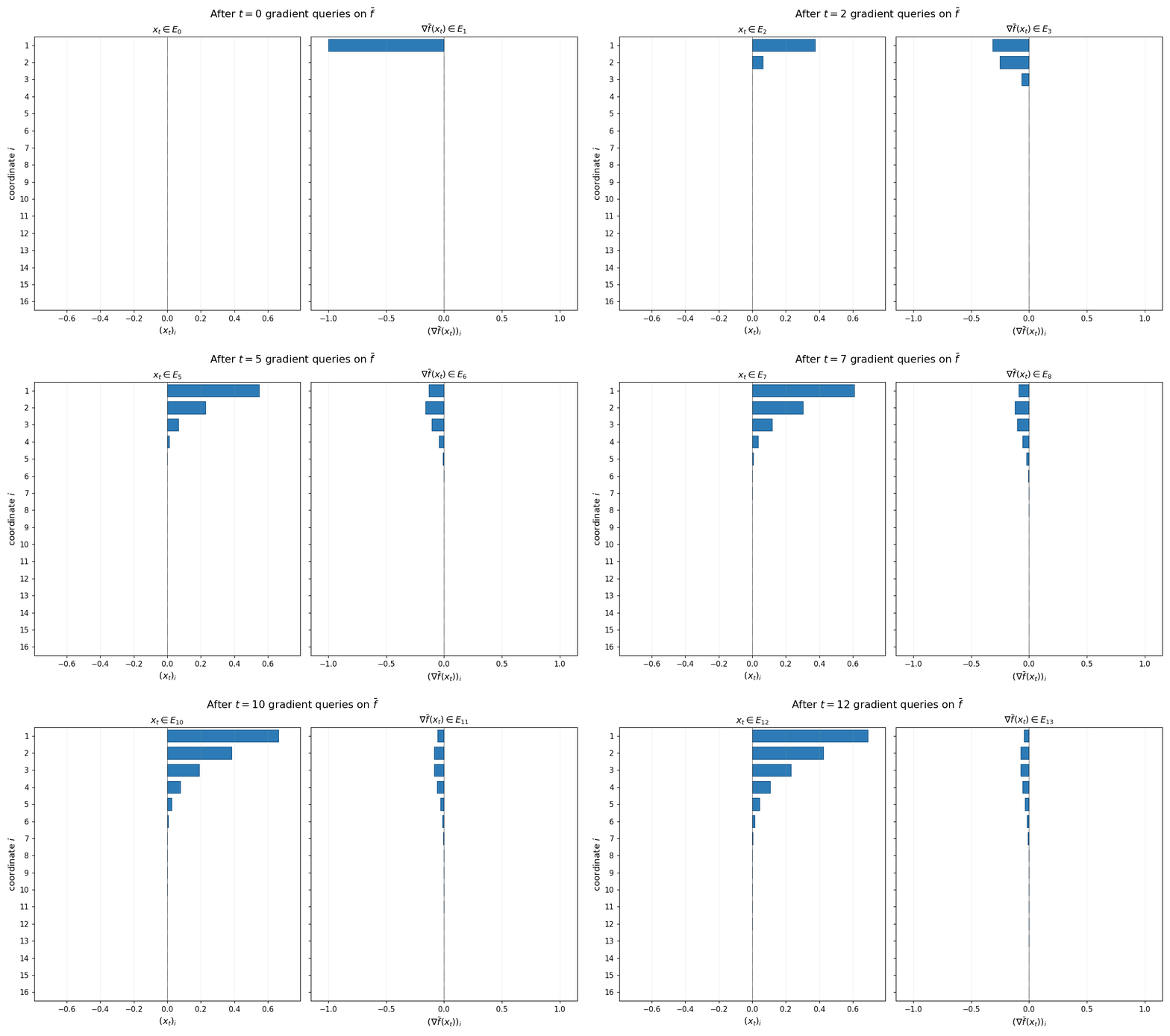
\[z^\ast_i \;=\; 1 - \frac{i}{d+1}, \qquad i = 1, \ldots, d;\]every coordinate of $z^\ast$ is nonzero, with magnitudes decreasing linearly from near $1$ at $i = 1$ to near $0$ at $i = d$. The chain property is immediate from tridiagonality of $T$: the $i$th entry of $\nabla\bar f(z) = Tz - e_1$ depends only on $z_{i-1}, z_i, z_{i+1}$, so a vector supported on the first $m$ coordinates produces a gradient supported on the first $m+1$. Hence $\bar f$ is a zero-chain quadratic.
The animation below shows the chain property at work: gradient descent is run on $\bar f$ from $w_0 = 0$, and at every step the supports of $w_t$ (left panel) and $\nabla\bar f(w_t)$ (right panel) are exactly ${1,\ldots,t}$ and ${1,\ldots,t+1}$. Untouched coordinates are gray; activated coordinates are blue.
Example (Rescaling). The class of zero-chain quadratics is closed under positive scalar rescaling of the input and output: if $\bar f$ is a zero-chain quadratic on $\mathbb{R}^d$ and $\alpha, \gamma > 0$ are any constants, then the rescaled function
\[f(w) \;:=\; \alpha\,\bar f(\gamma\,w)\]is itself a zero-chain quadratic. Indeed, the chain rule gives $\nabla f(w) = \alpha\gamma\,\nabla\bar f(\gamma w)$ and the zero-chain property follows immediately. This closure under rescaling will let us tune the smoothness constant and the initial distance $\lVert w_0 - w_\ast\rVert$ to any prescribed values without losing the chain structure.
If we had a guarantee that the iterates of any deterministic first-order method always satisfied $w_t \in E_{2t+1}$, the chain property would already yield a clean lower bound on $\lVert w_t - w_\ast\rVert$ from the part of the minimizer that the iterate cannot reach. Of course, no such guarantee holds — a method is free to query off-coordinate points. The next lemma resolves the difficulty: by composing a zero-chain quadratic with a carefully chosen rotation, we force any deterministic first-order method to discover new coordinates two at a time.
The rotation lemma
Lemma 9.1 (Rotation neutralizes arbitrary queries). Let $\bar f$ be a zero-chain quadratic on $\mathbb{R}^d$, fix $k \ge 0$, and assume $d \ge 2k + 2$. For every deterministic first-order algorithm $\mathcal{A}$ there exists an orthogonal matrix $Q \in \mathbb{R}^{d\times d}$ such that, when $\mathcal{A}$ is run on
\[f(w) \;:=\; \bar f(Q^\top w),\]the iterates $w_0, w_1, \ldots, w_k$ produced by $\mathcal{A}$ satisfy
\[Q^\top w_t \in E_{2t+1}, \qquad Q^\top \nabla f(w_t) \in E_{2t+2}, \qquad t = 0, 1, \ldots, k.\]So although $\mathcal{A}$ is allowed to query anywhere in $\mathbb{R}^d$, on the rotated instance its information is forced into the controlled ladder $E_1, E_3, E_5, \ldots$. The proof constructs the columns of $Q$ inductively, exploiting the fact that the algorithm, being deterministic, must commit to its $(t+1)$-st query before seeing how $Q$ is completed past the columns already used.
Proof. Write $Q = [q_1, q_2, \ldots, q_d]$, with the columns $q_i$ to be chosen orthonormal. We construct them two at a time, maintaining the invariant
\[Q^\top w_i \in E_{2i+1}, \qquad Q^\top g_i \in E_{2i+2}, \qquad g_i := \nabla f(w_i),\]for every completed round $i$. The animation below previews the construction: each round adds two new columns of $Q$ (orange strip on the right), the rotated iterate $Q^\top w_t$ acquires two new nonzero coordinates (heatmap column), and the rotated representations of earlier iterates remain frozen — the new $q$’s lie in the orthogonal complement of everything queried so far, so $Q^\top w_s$ for $s < t$ is unaffected by extending $Q$.
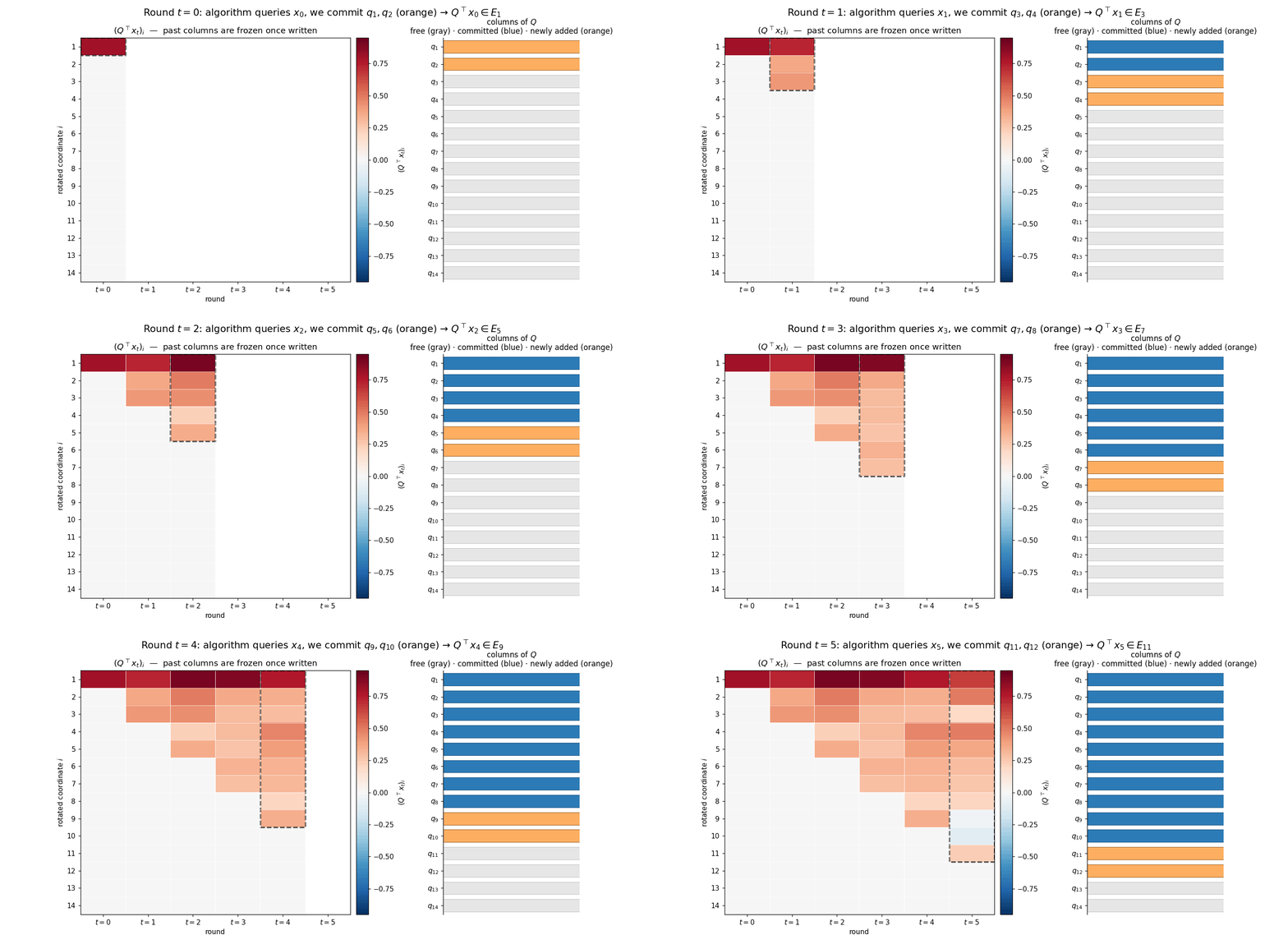
Base step ($t = 0$). The algorithm chooses $w_0$ before any gradients are available, so $w_0$ is a fixed deterministic vector. If $w_0 \neq 0$, choose $q_1 = w_0/\lVert w_0\rVert$; if $w_0 = 0$, choose $q_1$ to be any unit vector. In either case $w_0 \in \operatorname{span}\lbrace q_1\rbrace$, and therefore $Q^\top w_0 \in E_1$. Before the gradient oracle can return $g_0 = \nabla f(w_0) = Q\,\nabla\bar f(Q^\top w_0)$, we also commit $q_2$ to be any unit vector orthogonal to $q_1$. With $q_1, q_2$ fixed, the chain rule gives $Q^\top g_0 = \nabla \bar f(Q^\top w_0)$, and the chain property of $\bar f$ yields $Q^\top g_0 \in E_2$.
Inductive step. Suppose the invariant holds for rounds $0, \dots, t$ with $t \le k-1$, and that $q_1, \dots, q_{2t+2}$ have already been fixed. By assumption, $Q^\top w_i \in E_{2i+1}$ and $Q^\top g_i \in E_{2i+2}$ for all $i \le t$, so each of the past oracle answers $g_0, \dots, g_t$ is determined by the columns $q_1,\dots,q_{2t+2}$ alone. How we eventually complete $Q$ on the orthogonal complement of $\operatorname{span}\lbrace q_1,\dots,q_{2t+2}\rbrace$ does not affect any of those answers.
Since $\mathcal{A}$ is deterministic, the next iterate $w_{t+1} = \Phi_{t+1}(g_0, \dots, g_t)$ is a fixed vector of $\mathbb{R}^d$, known to us before any column of $Q$ outside $S_t := \operatorname{span}\lbrace q_1,\dots,q_{2t+2}\rbrace$ is committed. Decompose $w_{t+1}$ into its $S_t$- and $S_t^\perp$-components,
\[w_{t+1} = P_{S_t} w_{t+1} + \underbrace{P_{S_t^{\perp}} w_{t+1}}_{=:r_{t+1}},\]and choose the next basis vector along the orthogonal projection of $w_{t+1}$ onto $S_t^\perp$: if $r_{t+1} \neq 0$, set $q_{2t+3} = r_{t+1}/\lVert r_{t+1}\rVert$; otherwise let $q_{2t+3}$ be any unit vector in $S_t^\perp$. In either case $q_{2t+3} \perp S_t$ and $w_{t+1} \in \operatorname{span}\lbrace q_1,\dots,q_{2t+3}\rbrace$, so $Q^\top w_{t+1} \in E_{2t+3}$.
Next we commit one more column, $q_{2t+4}$, taken to be any unit vector in $S_t^\perp$ orthogonal to $q_{2t+3}$. Such a vector exists because $\dim S_t^\perp = d - (2t+2) \ge 2$ when $t \le k-1$ and $d \ge 2k+2$. With $q_1, \dots, q_{2t+4}$ now committed, the chain rule $\nabla f(w) = Q\,\nabla\bar f(Q^\top w)$ gives $Q^\top g_{t+1} = \nabla\bar f(Q^\top w_{t+1})$. Plugging the containment $Q^\top w_{t+1} \in E_{2t+3}$ into the chain property of $\bar f$ then yields
\[Q^\top g_{t+1} \in E_{2t+4},\]which completes the inductive step. The remaining columns $q_{2k+3}, \dots, q_d$ play no role during the first $k$ rounds and may be completed to an orthonormal basis arbitrarily once the algorithm has terminated. $\square$
Lemma 9.1 is the formal reason that off-Krylov queries do not break worst-case lower bounds. Such queries do break the literal claim that all iterates lie in a Krylov subspace, but on a suitably rotated zero-chain quadratic they still uncover new information only one dimension at a time. The lower-bound recipe is therefore:
- Pick a zero-chain quadratic $\bar f$, possibly after rescaling.
- Use Lemma 9.1 to reduce any deterministic first-order method on a rotated instance to a zero-respecting method on $\bar f$ — one whose iterates lie in the growing chain of coordinate subspaces $E_1 \subseteq E_3 \subseteq E_5 \subseteq \cdots$.
- Lower-bound the error of any point supported on only the first $2k+1$ coordinates.
Step 3 is now an explicit calculation on the tridiagonal example.
The lower bound
Theorem 9.2 (Lower bound). Fix $k \ge 1$ and $\beta, R > 0$, and set $d := 4k+2$. There exist a convex quadratic $f : \mathbb{R}^d \to \mathbb{R}$ with $\lVert\nabla^2 f\rVert_{\mathrm{op}} \le \beta$ and an initialization $w_0$ with $\lVert w_0 - w_\ast\rVert = R$ such that for every deterministic first-order algorithm $\mathcal{A}$ the iterates satisfy
\[f(w_k) - f^\ast \;\ge\; \frac{3}{128}\cdot\frac{\beta\,R^2}{(k+1)^2}.\]Proof. Set $d := 4k+2$ and let $\bar f(z) = \tfrac12 z^\top T z - z^\top e_1$ be the tridiagonal chain quadratic on $\mathbb{R}^d$, with $T$ the tridiagonal Hessian and $z^\ast$ its minimizer. Fix the rescalings
\[\alpha \;:=\; \frac{\beta\,R^2}{\lVert T\rVert_{\mathrm{op}}\,\lVert z^\ast\rVert^2}, \qquad \gamma \;:=\; \frac{\lVert z^\ast\rVert}{R}.\]By the rescaling example, $\tilde f(z) := \alpha\,\bar f(\gamma\,z)$ is itself a zero-chain quadratic. Lemma 9.1 applied to $\tilde f$ therefore furnishes an orthogonal $Q$ such that, when $\mathcal{A}$ is run from $w_0 = 0$ on the hard instance
\[f(w) \;:=\; \tilde f(Q^\top w) \;=\; \alpha\,\bar f\bigl(\gamma\,Q^\top w\bigr),\]the iterates satisfy
\[Q^\top w_t \;\in\; E_{2t+1}, \qquad \forall\, t = 0, 1, \ldots, k.\]This function $f$ has the required parameters: its Hessian is $\alpha\gamma^2\,Q T Q^\top$, so $\lVert\nabla^2 f\rVert_{\mathrm{op}} = \alpha\gamma^2\,\lVert T\rVert_{\mathrm{op}} = \beta$, and its minimizer is $w_\ast = Q\,z^\ast/\gamma$ with $\lVert w_0 - w_\ast\rVert = \lVert z^\ast\rVert/\gamma = R$.
Setting $v := \gamma\,Q^\top w_k \in E_{2k+1}$, we obtain
\[f(w_k) - f^\ast \;=\; \alpha\,\bigl(\bar f(v) - \bar f^\ast\bigr) \;\ge\; \alpha\,\bigl(\,\textstyle\min_{u \in E_{2k+1}}\,\bar f(u)\, -\, \bar f^\ast\bigr).\]The minimizer of $\bar f$ over $E_{2k+1}$ solves the truncated tridiagonal system $T_{2k+1}\,u_{1:2k+1} = e_1$, with explicit solution
\[u_i = 1 - \frac{i}{2k+2} \qquad\forall i \le 2k+1,\]and $u_i = 0$ otherwise. Since any minimizer of $y$ of a truncated chain satisfies $T_m\,y_{1:m} = e_1$, plugging this expression into $\bar f$ directly shows $\bar f(y) = -\tfrac{1}{2}\,y_1$. Therefore we deduce
\[\min_{u \in E_{2k+1}} \bar f(u) - \bar f^\ast \;=\; \frac{1}{2}\!\left[\frac{d}{d+1} - \frac{2k+1}{2k+2}\right] \;=\; \frac{d - 2k - 1}{2\,(d+1)(2k+2)} \;=\; \frac{2k+1}{2\,(4k+3)(2k+2)}.\]The elementary bounds $\lVert T\rVert_{\mathrm{op}} \le 4$ and
\[\lVert z^\ast\rVert^2 \;=\; \frac{1}{(d+1)^2}\sum_{i=1}^d i^2 \;=\; \frac{d(2d+1)}{6(d+1)} \;\le\; \frac{d}{3} \;=\; \frac{4k+2}{3}\]yield $\alpha \ge 3\,\beta R^2 / (4(4k+2))$. Substituting gives
\[f(w_k) - f^\ast \;\ge\; \frac{3\,\beta R^2}{4(4k+2)} \cdot \frac{2k+1}{2(4k+3)(2k+2)} \;=\; \frac{3\,\beta R^2}{32\,(4k+3)\,(k+1)} \;\ge\; \frac{3}{128}\cdot\frac{\beta R^2}{(k+1)^2},\]as claimed. $\square$
The bound matches the upper bound $\beta R^2/(8k^2)$ of Theorem 6.2 up to an absolute constant: the $O(\sqrt{\beta R^2/\varepsilon})$ iteration complexity of Chebyshev acceleration and conjugate gradients in the smooth convex regime is therefore optimal among deterministic first-order methods on quadratics, even allowing arbitrary off-Krylov queries.
The hard quadratic and the rotation argument are due to Nemirovski and Yudin [NY83]; modern treatments appear in Nesterov [Nes04, Nes18]. The same chain construction underlies the corresponding lower bounds for general smooth strongly convex and smooth convex minimization beyond the quadratic class, with only minor adjustments to the choice of $T$ and the way the chain quadratic is embedded in $\mathbb{R}^d$.
Lower bounds with structured spectrum
Theorem 9.2 closes the gap in the worst case: no deterministic first-order method beats Chebyshev/CG on every quadratic with $\lVert\nabla^2 f\rVert_{\mathrm{op}} \le \beta$. Recall, however, that Section 7 showed that structured spectra — power-law densities $\phi(\lambda) = M\lambda^{a-1}$ and Marchenko–Pastur laws, for instance — yield much faster CG rates than the worst case allows. A natural question is whether these structured rates are themselves tight against arbitrary deterministic first-order methods.
The answer is that the structured rate is tight: the same residual polynomial that drives the CG upper bound also certifies a matching lower bound for every deterministic first-order method, up to a constant shift $k \mapsto 2k+1$. Our goal is to show why this is the case.
We begin by recalling from Section 7 the spectral measure $\mu := \sum_{i=1}^d c_i^2\,\delta_{\lambda_i}$ on $[0,\beta]$, where $c_i$ are the coordinates of the initial error $w_0 - w_\ast$ in the eigenbasis of $H$. Rewriting $(4b)$ as an integral against $\mu$ gives the spectral-measure form of the CG identity:
\[f(w_k^{\mathrm{CG}}) - f^\ast \;=\; \tfrac{1}{2}\min_{\substack{p \in \mathcal{P}_k \\ p(0) = 1}}~\int_0^\beta \lambda\,p(\lambda)^2\,d\mu(\lambda), \tag{61}\]We will now show that the conjugate gradient method is optimal in a much stronger sense than the minimax bound we have already proved: the worst-case instance for any deterministic first-order algorithm can be chosen to have any prescribed spectral measure.
We will need the following simple helper lemma. We call a tridiagonal matrix $H\in\mathbb{R}^{d\times d}$ irreducible if all of its off-diagonal entries are nonzero:
\[H_{i,i+1} = H_{i+1,i} \ne 0, \qquad \forall\, i = 1, \ldots, d-1.\]Lemma 9.3 (Krylov subspaces of irreducible tridiagonal matrices). If $H \in \mathbb{R}^{d \times d}$ is irreducible and tridiagonal, then the Krylov subspace $\mathcal{K}_t(H, e_1)$ coincides with the coordinate subspace $E_t$ for every $t \ge 1$.
Proof. Since $H$ is tridiagonal, the inclusion $H E_m \subset E_{m+1}$ holds, and therefore
\[\operatorname{span}\{e_1,\, He_1,\, \ldots,\, H^{m-1} e_1\} \subset E_m. \tag{62}\]Conversely, the $(j+1)$-st coordinate of $H^j e_1$ is
\[H_{j+1,j}\,H_{j,j-1}\cdots H_{2,1},\]which is nonzero by irreducibility. Thus we have $H^j e_1 \in E_{j+1} \setminus E_j$, and by dimension counting the inclusion $(62)$ holds as equality. $\square$
Next, we need the following lemma that constructs an irreducible, positive semidefinite, tridiagonal problem with any prescribed spectral measure.
Lemma 9.4 (Exact Jacobi realization of a finite measure). Consider an atomic measure $\mu = \sum_{i=1}^d \rho_i\,\delta_{\theta_i}$ with atoms $0 < \theta_1 < \cdots < \theta_d \le \beta$ and weights $\rho_i > 0$. Then there exist an irreducible, positive-semidefinite, tridiagonal matrix $H \in \mathbb{R}^{d \times d}$ with $\lVert H\rVert_{\mathrm{op}} \le \beta$ and a scalar $\tau > 0$ such that the spectral measure $\mu_{H,w_\ast}$ of the convex quadratic problem with data
\[w_0 = 0, \qquad b := \tau e_1, \qquad w_\ast := H^{-1} b,\]coincides exactly with $\mu$.
Proof. Set $M_2 := \int \lambda^2\,d\mu$ and define
\[d\nu \;:=\; \frac{\lambda^2}{M_2}\,d\mu.\]Then $\nu$ is a probability measure supported on the same $d$ atoms as $\mu$. The space $L^2(\nu)$ is simply the $d$-dimensional space of functions on these atoms, and the monomials $1, \lambda, \ldots, \lambda^{d-1}$ span it. Applying Gram–Schmidt to these monomials, we obtain an orthonormal basis
\[q_0 \equiv 1,\; q_1,\; \ldots,\; q_{d-1},\]where $q_i$ has degree exactly $i$ and is orthogonal to every polynomial of degree at most $i-1$.
Let $M_\lambda$ be the operator of multiplication by $\lambda$ on $L^2(\nu)$, and let $H$ be its matrix in the basis ${q_0, \ldots, q_{d-1}}$, that is:
\[H_{ij} \;:=\; \langle q_{i-1},\, \lambda\,q_{j-1}\rangle_{L^2(\nu)}, \qquad i,j = 1, \ldots, d.\]The matrix $H$ is symmetric. It is also tridiagonal: if $i > j+1$, then $\lambda\,q_{j-1}$ has degree $j \le i-2$ and is therefore orthogonal to $q_{i-1}$. Symmetry gives the same conclusion when $i < j-1$.
We next show that $H$ is irreducible. Choose each $q_n$ to have positive leading coefficient $\kappa_n > 0$. Comparing leading terms in the expansion of $\lambda\,q_n$ in the orthonormal basis gives
\[\lambda\,q_n \;=\; \frac{\kappa_n}{\kappa_{n+1}}\,q_{n+1} + \text{lower-degree terms}.\]Taking inner products with $q_{n+1}$, we get
\[H_{n+2,n+1} \;=\; \langle q_{n+1},\, \lambda\,q_n\rangle_{L^2(\nu)} \;=\; \frac{\kappa_n}{\kappa_{n+1}} \;>\; 0.\]Thus every off-diagonal entry of $H$ is nonzero.
The spectral bounds are immediate from the multiplication operator. If $p \in L^2(\nu)$ is nonzero, then
\[\langle p,\, M_\lambda\,p\rangle_{L^2(\nu)} \;=\; \int \lambda\,p(\lambda)^2\,d\nu(\lambda) \;>\; 0,\]and, since $\nu$ is supported on $(0, \beta]$,
\[\langle p,\, M_\lambda\,p\rangle_{L^2(\nu)} \;\le\; \beta\,\lVert p\rVert_{L^2(\nu)}^2.\]Hence $H$ is positive definite and $\lVert H\rVert_{\mathrm{op}} \le \beta$.
It remains to identify the spectral measure. For any vector $z$ and any polynomial $p$, the spectral measure of $z$ satisfies
\[z^\top p(H)\,z \;=\; \int p(\lambda)\,d\mu_{H,z}(\lambda); \tag{63}\]this is immediate from an eigenvalue decomposition of $H$. Set $\tau := \sqrt{M_2}$, $b := \tau\,e_1$, and
\[w_\ast \;:=\; H^{-1} b \;=\; \tau\,H^{-1} e_1.\]The vector $e_1$ corresponds to the constant polynomial $q_0 \equiv 1$, and $H$ represents multiplication by $\lambda$. Therefore, for every polynomial $p$, we have
\[\begin{aligned} (w_\ast)^\top p(H)\,w_\ast &= \tau^2\,e_1^\top H^{-1} p(H)\,H^{-1} e_1 \\ &= \tau^2\,\langle 1,\, \lambda^{-1}\,p(\lambda)\,\lambda^{-1}\rangle_{L^2(\nu)} \\ &= \tau^2 \int \lambda^{-2}\,p(\lambda)\,d\nu(\lambda) \\ &= \int p(\lambda)\,d\mu(\lambda). \end{aligned}\]Combining this identity with $(63)$ shows that $\mu_{H,w_\ast}$ and $\mu$ integrate every polynomial in the same way. Since both measures are finite atomic, they are equal. $\square$
We are now ready to prove the optimality of CG. To simplify notation, for a positive measure $\nu$ on $(0,\beta]$, define
\[\mathcal{E}_t(\nu) \;:=\; \tfrac{1}{2}\min_{\substack{p \in \mathcal{P}_t \\ p(0)=1}}\int_0^\beta \lambda\,p(\lambda)^2\,d\nu(\lambda).\]Theorem 9.5 (Optimality of CG). Fix an iteration counter $t \ge 0$, a constant $\beta > 0$, and a finite positive atomic measure $\mu$ on $(0,\beta]$ that has at least $2t+2$ atoms. Then for every deterministic first-order algorithm there exists a convex quadratic problem instance whose spectral error measure $\mu_{H,w_\ast}$ is exactly $\mu$ and whose $t$-th iterate after initialization $w_0 = 0$ satisfies
\[f(w_t) - f^\ast \;\ge\; \mathcal{E}_{2t+1}(\mu).\]Proof. Fix a deterministic first-order algorithm $\mathcal{A}$, and write
\[\mu \;=\; \sum_{i=1}^d \rho_i\,\delta_{\lambda_i}, \qquad 0 < \lambda_1 < \cdots < \lambda_d \le \beta, \qquad w_i > 0,\]where $d \ge 2t + 2$. Applying Lemma 9.4 to $\mu$, we obtain an irreducible, tridiagonal, positive semidefinite matrix $H$ with $\lVert H\rVert_{\mathrm{op}} \le \beta$, a scalar $\tau > 0$, and the vector $b = \tau e_1$ such that the quadratic
\[\bar f(z) \;=\; \tfrac{1}{2} z^\top H z - b^\top z\]has minimizer $w_\ast = H^{-1}b$ and spectral error measure $\mu_{H,w_\ast} = \mu$.
Moreover $\bar f$ is zero-chain, since tridiagonality gives $H E_m \subset E_{m+1}$ and $b \in E_1$. Applying Lemma 9.1, we deduce that there is an orthogonal matrix $Q$ such that the algorithm $\mathcal{A}$ applied to
\[f(w) \;=\; \bar f(Q^\top w)\]produces iterates satisfying
\[Q^\top w_s \in E_{2s+1}, \qquad \forall\, s = 0, 1, \ldots, t.\]Orthogonal changes of variables preserve the spectral error measure, and therefore the rotated instance $f$ also has spectral error measure $\mu$. Since $2t+1 \le d$ and $b$ is a nonzero multiple of $e_1$, the helper lemma above ensures the equality
\[E_{2t+1} \;=\; \mathcal{K}_{2t+1}(H, b).\]Thus the inclusion $Q^\top w_t \in \mathcal{K}_{2t+1}(H, b)$ holds, and consequently
\[f(w_t) - f^\ast \;=\; \bar f(Q^\top w_t) - \bar f^\ast \;\ge\; \min_{u \,\in\, \mathcal{K}_{2t+1}(H,b)} \bar f(u) - \bar f^\ast.\]Using the Krylov polynomial identity $(61)$ and the equality $\mu_{H,w_\ast} = \mu$, the right-hand side equals $\mathcal{E}_{2t+1}(\mu)$, which completes the proof. $\square$
Let us spell out what the construction gives in two common spectral regimes.
Example (Atomic power laws). For $a > -1$ and $d \ge 2t + 2$, set
\[\mu_d \;=\; \sum_{i=1}^d \rho_i\,\delta_{\lambda_i}, \qquad \lambda_i \asymp \frac{i}{d}, \qquad \rho_i \asymp d^{-a}\,i^{a-1}.\]Theorem 9.5 gives the lower bound $\mathcal{E}_{2t+1}(\mu_d)$. For $d$ large relative to $t$, the atomic measure $\mu_d$ is a Riemann discretization of the continuum power-law density $\phi(\lambda) = \lambda^{a-1}$ on $(0,1]$, so
\[\mathcal{E}_{2t+1}(\mu_d) \;\asymp\; \min_{\substack{p \in \mathcal{P}_t \\ p(0)=1}}\; \int \lambda\,p(\lambda)^2\,\lambda^{a-1}\,d\lambda \;\asymp\; t^{-2(a+1)}.\]This is exactly the rate established for CG under a power-law spectral density in Theorem 7.6. Thus the lower bound scales as $t^{-2(a+1)}$, matching the CG upper bound up to the universal $k \leftrightarrow 2k+1$ degree shift.
Example (Atomic Marchenko–Pastur hard edge). For $d \ge 2t + 2$, set
\[\mu_d \;=\; \sum_{i=1}^d \rho_i\,\delta_{\lambda_i}, \qquad \lambda_i \asymp \left(\frac{i}{d}\right)^{\!2}, \qquad \rho_i \asymp d^{-1}.\]Then $\mu_d([0, s]) \asymp s^{1/2}$, so the continuum hard-edge limit is the power-law case $a = 1/2$. For $d$ large relative to $t$,
\[\mathcal{E}_{2t+1}(\mu_d) \;\asymp\; \min_{\substack{p \in \mathcal{P}_t \\ p(0)=1}}\; \int \lambda\,p(\lambda)^2\,\lambda^{-1/2}\,d\lambda \;\asymp\; t^{-3}.\]This is the $a = 1/2$ specialization of the previous example via Theorem 7.6, and matches the $k^{-3}$ Marchenko–Pastur CG rate established in Theorem 7.5. Thus the lower bound scales as $t^{-3}$.
Theorem 9.5 is stated for finite atomic measures, but the natural spectral models in Section 7 — power-law densities and the Marchenko–Pastur law — are continuous. We now show that this distinction is irrelevant for any fixed iteration counter $t$: for any prescribed positive measure $\mu$ on $(0,\beta]$ and any deterministic first-order algorithm, there is a hard instance in $\mathbb{R}^{2t+2}$ matching the lower bound from Theorem 9.5, with a spectral measure that is indistinguishable from $\mu$ when tested against polynomials of degree at most $4t+3$. This is the content of Theorem 9.7 below.
The construction relies on a classical ingredient: Gauss quadrature. This basic technique, summarized in Lemma 9.6, shows that for any nondegenerate measure $\mu$ on a compact interval, there exists a measure $\mu_N$ supported only on $N$ points, such that every polynomial of degree at most $2N-1$ integrates to the same quantity with respect to both $\mu$ and $\mu_N$. In this way, we can reduce a general measure $\mu$ to an atomic measure $\mu_N$ supported on $N \approx t$ points, to which Theorem 9.5 then applies.
Lemma 9.6 (Gauss quadrature). Let $\mu$ be a positive Borel measure on $[0,\beta]$ supported on at least $N+1$ distinct points, with finite moments up to order $2N-1$. Then there exist points $\theta_1 < \cdots < \theta_N$ in the interior of the convex hull of $\mathrm{supp}(\mu)$ and positive weights $w_1,\ldots,w_N > 0$ such that the atomic measure
\[\mu_N \;:=\; \sum_{j=1}^N \rho_j\,\delta_{\theta_j} \tag{64}\]agrees with $\mu$ on every polynomial of degree at most $2N-1$:
\[\int P\,d\mu_N \;=\; \int P\,d\mu \qquad \text{for every } P \in \mathcal{P}_{2N-1}. \tag{$\dagger$}\]The measure $\mu_N$ is called the $N$-point Gauss quadrature rule for $\mu$. Figure 9.1 illustrates the rule for a Beta-like density: just $N=5$ atoms suffice to reproduce the continuous integral exactly on every polynomial of degree at most $2N-1 = 9$.
![Gauss quadrature for a non-uniform measure on $[0,1]$: left, the continuous density (blue) and the $N=5$ atoms of $\mu_N$ (red stems with heights proportional to the weights $w_j$); right, a test polynomial $P \in \mathcal{P}_9$ together with its values at the Gauss nodes — the continuous integral $\int P\,d\mu$ equals the discrete sum $\sum_j w_j\,P(\theta_j)$ exactly.](/DSC-243/figures/gauss_quadrature.png)
Proof. We will choose the nodes first, then choose the weights so that all lower-degree polynomials are integrated correctly.
Apply Gram–Schmidt in $L^2(\mu)$ to the monomials ${1,\lambda,\ldots,\lambda^N}$, producing orthonormal polynomials $\tilde p_0,\ldots,\tilde p_N$ with $\deg \tilde p_n=n$. This construction is well-defined: after subtracting the projection of $\lambda^n$ onto the lower-degree polynomials, the remaining polynomial cannot have zero $L^2(\mu)$ norm unless it vanishes on $\mathrm{supp}(\mu)$; but a nonzero polynomial of degree at most $n\le N$ cannot vanish on the at least $N+1$ distinct support points of $\mu$. Take the quadrature nodes $\theta_1<\cdots<\theta_N$ to be the roots of $\tilde p_N$.
We claim that these roots are real, simple, and lie in the interior of the convex hull of $\mathrm{supp}(\mu)$. The key point is that $\tilde p_N$ must change sign at least $N$ times across the support of $\mu$. To see this, suppose instead that it changes sign only $m<N$ times. Let $\xi_1<\cdots<\xi_m$ denote the corresponding sign-change locations. Between consecutive $\xi_i$’s, the sign of $\tilde p_N$ is constant, and crossing a $\xi_i$ flips the sign. Hence the polynomial
\[r(\lambda):=\prod_{i=1}^m(\lambda-\xi_i)\]changes sign at exactly the same locations. After multiplying $r$ by $-1$ if necessary, we therefore have $\tilde p_N(\lambda)\,r(\lambda)\ge 0$ for every $\lambda\in \mathrm{supp}(\mu)$. Moreover, the product is not identically zero on $\mathrm{supp}(\mu)$: otherwise $\tilde p_N$ would vanish on all of $\mathrm{supp}(\mu)$ except possibly the $m$ points $\xi_i$, forcing the degree-$N$ polynomial $\tilde p_N$ to have too many zeros. Since we have $r\in \mathcal{P}_m\subseteq \mathcal{P}_{N-1}$, we get
\[\int \tilde p_N(\lambda)\,r(\lambda)\,d\mu(\lambda)>0,\]contradicting the orthogonality $\tilde p_N \perp \mathcal{P}_{N-1}$.
Thus $\tilde p_N$ has at least $N$ sign changes on the support. Each sign change gives a distinct real zero, while $\deg \tilde p_N=N$, so these are exactly the $N$ distinct roots of $\tilde p_N$. The roots lie between support points, hence in the interior of the convex hull of $\mathrm{supp}(\mu)$.
Now let $\ell_j$ be the polynomial:
\[\ell_j(\lambda):=\prod_{i\ne j}\frac{\lambda-\theta_i}{\theta_j-\theta_i} \qquad\textrm{and note}\qquad \ell_j(\theta_i)=\mathbf{1}_{i=j},\]Define the weights
\[\rho_j:=\int \ell_j(\lambda)\,d\mu(\lambda).\]We claim that these weights give exact integration on $\mathcal{P}_{2N-1}$. Fix $P\in \mathcal{P}_{2N-1}$. Since $\tilde p_N$ is a degree-$N$ polynomial, ordinary polynomial long division lets us write $P$ uniquely as
\[P = \tilde p_N\,s + r, \qquad \deg(s),\,\deg(r) \le N-1.\]Here $s$ is the quotient and $r$ is the remainder. This decomposition is useful because the quotient term $\tilde p_N\,s$ contributes nothing to either side of the desired identity. Against $\mu$, it integrates to zero by orthogonality, since $s\in\mathcal{P}_{N-1}$ and $\tilde p_N$ is orthogonal to $\mathcal{P}_{N-1}$. Against $\mu_N$, it also integrates to zero because $\mu_N$ is supported exactly on the roots $\theta_j$ of $\tilde p_N$. Therefore, to prove exactness for $P$, it remains only to prove exactness for the lower-degree remainder $r\in\mathcal{P}_{N-1}$.
Now use the fact that a polynomial of degree at most $N-1$ is completely determined by its values at $N$ distinct points. The Lagrange polynomials $\ell_1,\ldots,\ell_N$ were built precisely for this purpose: $\ell_j(\theta_i)=\mathbf{1}_{i=j}$, so the linear combination
\[\sum_{j=1}^N r(\theta_j)\,\ell_j.\]has the same value as $r$ at every node $\theta_i$. Since both sides have degree at most $N-1$, equality at the $N$ distinct nodes forces equality $r=\sum_{j=1}^N r(\theta_j)\,\ell_j$ as polynomials. Therefore
\[\int r\,d\mu =\sum_{j=1}^N r(\theta_j)\int \ell_j\,d\mu =\sum_{j=1}^N r(\theta_j)\rho_j =\int r\,d\mu_N.\]This proves exactness for the remainder. It remains only to check that the weights are positive. The polynomial $\ell_j-\ell_j^2$ vanishes at every node $\theta_i$, so it is divisible by $\tilde p_N$:
\[\ell_j-\ell_j^2=\tilde p_N\,h_j\]for some $h_j\in\mathcal{P}_{N-2}$. Orthogonality again gives $\int \tilde p_N h_j\,d\mu=0$, and therefore
\[\rho_j=\int \ell_j\,d\mu=\int \ell_j^2\,d\mu>0.\]Combining this with the reduction from $P$ to $r$ proves $(\dagger)$. $\square$
Combining the Gauss quadrature reduction of Lemma 9.6 with the atomic optimality result of Theorem 9.5 immediately delivers the general lower bound promised at the start of this subsection.
Theorem 9.7 (Optimality of CG up to low-degree moments). Fix an iteration counter $t \ge 0$, a constant $\beta > 0$, and a positive Borel measure $\mu$ on $(0,\beta]$ supported on at least $2t+3$ distinct points. Then for every deterministic first-order algorithm there exists a convex quadratic problem instance on $\mathbb{R}^{2t+2}$ whose spectral error measure $\mu_{H,w_\ast}$ agrees with $\mu$ on $\mathcal{P}_{4t+3}$ and whose $t$-th iterate after initialization $w_0 = 0$ satisfies
\[f(w_t) - f^\ast \;\ge\; \mathcal{E}_{2t+1}(\mu).\]Proof. Fix a deterministic first-order algorithm and set $N := 2t + 2$. By Lemma 9.6, the $N$-point Gauss quadrature rule
\[\mu_N \;=\; \sum_{j=1}^N \rho_j\,\delta_{\theta_j}, \qquad 0 < \theta_1 < \cdots < \theta_N \le \beta, \qquad w_j > 0,\]agrees with $\mu$ on $\mathcal{P}_{2N-1} = \mathcal{P}_{4t+3}$. Applying Theorem 9.5 to $\mu_N$, we obtain a convex quadratic instance on $\mathbb{R}^N$ whose spectral error measure equals $\mu_N$ exactly and whose $t$-th iterate satisfies
\[f(w_t) - f^\ast \;\ge\; \mathcal{E}_{2t+1}(\mu_N).\]For every $p \in \mathcal{P}_{2t+1}$, the integrand $\lambda\,p(\lambda)^2$ has degree at most $4t+3$, so the moment-matching identity gives $\mathcal{E}_{2t+1}(\mu_N) = \mathcal{E}_{2t+1}(\mu)$, completing the proof. $\square$
A statistical lower bound for stochastic algorithms
We now turn from optimization on a fixed deterministic objective to estimation from noisy stochastic samples. The setting is the streaming least-squares problem of Section 8 specialized to the well-specified additive Gaussian noise model
\[y \;=\; \langle w_\ast, x\rangle + \eta, \qquad \eta \sim \mathcal{N}(0,\sigma^2)\ \text{independent of}\ x.\]In this regime $\Sigma = \sigma^2 H$ gives $\sigma_{\mathrm{MLE}}^2 = \tfrac12 d\sigma^2$ and $\rho_{\mathrm{misspec}} = 1$, and the variance bound of Theorem 8.2 (after a burn-in long enough to eliminate the bias and at $\gamma R^2 = \tfrac12$) reduces to $4d\sigma^2/(T-t)$. We show that this $d\sigma^2/T$ scaling is sharp: no algorithm processing $T$ stochastic samples can achieve lower variance. Tail-averaged constant-stepsize SGD is therefore minimax-optimal on the well-specified least-squares problem.
The argument is short and elegant, and adapts Mourtada’s [Mou22] fixed-design proof to the streaming setting. Recall that the population least-squares risk is
\[L(w) \;:=\; \tfrac{1}{2}\,\mathbb{E}_{(x,y)}\!\left[(y - \langle w, x\rangle)^2\right],\]minimized at $w_\ast$, and the excess risk decomposes as $L(w) - L(w_\ast) = \tfrac{1}{2}\,\lVert w - w_\ast\rVert_H^2$, where $H := \mathbb{E}[x x^\top]$ is the feature covariance.
We will also use the following elementary fact from Bayesian estimation.
Lemma 9.8 (Bayes estimator). Let $(w, z)$ be a pair of random vectors with $z$ observed and $w$ unknown, and fix a matrix $M \succeq 0$. Among all measurable estimators $a(z)$, the quantity
\[\mathbb{E}\,\lVert a(z) - w\rVert_M^2\]is minimized by the conditional expectation $a(z) = \mathbb{E}[w \mid z]$. Moreover, if for each $z$ the conditional density $w \mapsto p(w \mid z)$ is Gaussian, then $\mathbb{E}[w \mid z]$ coincides with the unique maximizer of $w \mapsto p(w \mid z)$.
Proof. Write $m(z) := \mathbb{E}[w \mid z]$. Conditioning on $z$ and expanding the squared $M$-norm gives
\[\begin{aligned} \mathbb{E}\!\left[\lVert a(z)-w\rVert_M^2 \mid z\right] &= \lVert a(z)-m(z)\rVert_M^2 \\ &\qquad + \mathbb{E}\!\left[\lVert m(z)-w\rVert_M^2 \mid z\right], \end{aligned}\]since the cross term has conditional expectation zero. The second term does not depend on $a$, so the first term is minimized by $a(z)=m(z)$. The second claim follows since a Gaussian density is symmetric about its mean, so when $p(\cdot \mid z)$ is Gaussian its unique maximizer is $\mathbb{E}[w \mid z]$. $\square$
Theorem 9.9 (Minimax lower bound for streaming least squares). *Fix $T \ge 1$, a noise level $\sigma > 0$, and a distribution on $\mathbb{R}^d$ with positive-definite covariance $H = \mathbb{E}[x x^\top]$. Suppose the well-specified Gaussian-noise model $y = \langle w_\ast, x\rangle + \eta$ with $\eta \sim \mathcal{N}(0, \sigma^2)$ independent of $x$. Then given $T$ iid samples $(x_1, y_1), \ldots, (x_T, y_T)$ and any (possibly randomized) measurable estimator $\hat w = \hat w(x_1, y_1, \ldots, x_T, y_T)$, there exists $w_{\ast}$ satisfying
\[\mathbb{E}\bigl[L(\hat w) - L(w_\ast)\bigr] \;\ge\; \frac{\sigma^2 d}{2T}.\]Proof. By the excess-risk identity, $L(\hat w) - L(w_\ast) = \tfrac{1}{2}\,\lVert \hat w - w_\ast\rVert_H^2$, so it suffices to lower bound
\[\sup_{w_\ast}\,\mathbb{E}\,\lVert \hat w - w_\ast\rVert_H^2.\]The supremum over $w_\ast$ is bounded below by the expected error under any prior on $w_\ast$. We choose the Gaussian prior $w_\ast \sim \mathcal{N}\bigl(0, \tfrac{\sigma^2}{T\lambda}\,I_d\bigr)$, with $\lambda > 0$ to be sent to zero at the end of the proof. Stack the samples into the data matrix $X \in \mathbb{R}^{T \times d}$ whose $i$-th row is $x_i^\top$, write $\hat H := \tfrac{1}{T}\,X^\top X$ for the empirical covariance, and set $y := X\,w_\ast + \eta$ with $\eta \sim \mathcal{N}(0, \sigma^2 I_T)$ independent of both $w_\ast$ and $X$.
Identifying the Bayes estimator. Set $m(X,y) := \mathbb{E}[w_\ast \mid X, y]$. By Lemma 9.8 applied to the random pair $\bigl(w_\ast,\,(X,y)\bigr)$ with weighting matrix $H$, every estimator $\hat w(X,y)$ satisfies $\mathbb{E}\,\lVert \hat w - w_\ast\rVert_H^2 \ge \mathbb{E}\,\lVert m(X,y) - w_\ast\rVert_H^2$. The conditional density of $w_\ast$ given $(X,y)$ is Gaussian (by Bayes’ rule), so Lemma 9.8 also identifies $m(X,y)$ as the maximizer over $w_\ast$ of $p(w_\ast \mid X, y)$. By Bayes’ rule, $p(w_\ast \mid X, y) \propto p(y \mid w_\ast, X)\,p(w_\ast)$ as a function of $w_\ast$ (the constant of proportionality $p(y \mid X)$ does not depend on $w_\ast$), and inserting the Gaussian densities $y \mid w_\ast, X \sim \mathcal{N}(X w_\ast, \sigma^2 I_T)$ and $w_\ast \sim \mathcal{N}(0, \tfrac{\sigma^2}{T\lambda} I_d)$ gives, on a log scale,
\[\log p(w_\ast \mid X, y) \;=\; -\frac{1}{2\sigma^2}\,\lVert y - X\,w_\ast\rVert^2 \;-\; \frac{T\lambda}{2\sigma^2}\,\lVert w_\ast\rVert^2 \;+\; \text{const},\]where the constant collects all terms independent of $w_\ast$.
Equivalently, $m(X,y)$ minimizes the ridge cost $\lVert y - X w\rVert^2 + T\lambda\,\lVert w\rVert^2$. Differentiating in $w$ and setting the derivative to zero yields the expression
\[m(X, y) \;=\; (X^\top X + T\lambda I)^{-1}\,X^\top y \;=\; \tfrac{1}{T}\,(\hat H + \lambda I)^{-1}\,X^\top y.\]Computing the Bayes risk. Substituting $y = X\,w_\ast + \eta$ and using the identity $(X^\top X + T\lambda I)^{-1}\,X^\top X - I = -T\lambda\,(X^\top X + T\lambda I)^{-1}$ gives the bias–variance decomposition
\[m(X, y) - w_\ast \;=\; -\lambda\,(\hat H + \lambda I)^{-1}\,w_\ast \;+\; \tfrac{1}{T}\,(\hat H + \lambda I)^{-1}\,X^\top \eta.\]We now take the $H$-norm of both sides. Independence of $w_\ast$, $\eta$, and $X$ kills the cross term in $\lVert\,\cdot\,\rVert_H^2$. Computing the two diagonal contributions with $\mathbb{E}[w_\ast w_\ast^\top] = \tfrac{\sigma^2}{T\lambda}\,I$ and $\mathbb{E}[\eta\eta^\top] = \sigma^2 I_T$ yields, after the factorization $\lambda H + H^2 = H(\lambda I + H)$, the estimate
\[\mathbb{E}_{w_\ast, \eta \mid X}\,\lVert m(X, y) - w_\ast\rVert_H^2 \;=\; \frac{\sigma^2}{T}\,\mathrm{Tr}\!\bigl[(\hat H + \lambda I)^{-1}\, H\bigr].\]Averaging over $X$. Operator convexity of $M \mapsto M^{-1}$ on $\mathbb{S}^d_{++}$, applied to the random PSD matrix $\hat H + \lambda I$ with mean $H + \lambda I$, gives the operator Jensen inequality
\[\mathbb{E}_X\!\bigl[(\hat H + \lambda I)^{-1}\bigr] \;\succeq\; (H + \lambda I)^{-1}.\]Taking the trace against $H \succ 0$ and letting $\lambda \downarrow 0$ yields
\[\mathbb{E}_X\,\mathrm{Tr}\!\bigl[(\hat H + \lambda I)^{-1}\, H\bigr] \;\ge\; \mathrm{Tr}\!\bigl[(H + \lambda I)^{-1}\, H\bigr] \;\xrightarrow{\lambda \downarrow 0}\; \mathrm{Tr}\!\bigl[H^{-1}\, H\bigr] \;=\; d.\]Inserting the factor of $\tfrac{1}{2}$ from the excess-risk identity completes the proof. $\square$
The matching with Theorem 8.2 is direct: under the well-specified Gaussian-noise model, the variance term collapses to $4\sigma^2 d/(T-t)$ and the lower bound to $\sigma^2 d/(2T)$, so the two differ only by an absolute constant. No stochastic algorithm processing $T$ samples can beat the $\sigma^2 d/T$ rate of streaming SGD on this problem; in particular, neither tail averaging, mini-batching, nor any more elaborate scheme can extract more than $O(\sigma^2 d/T)$ excess risk.
Theorem 9.9 is the random-design, well-specified Gaussian-noise instance of the classical $\sigma^2 d/n$ minimax bound for linear regression; the elegant Bayesian-Gaussian-prior proof we follow adapts Mourtada’s [Mou22] fixed-design argument, with the single extra operator-Jensen step needed to handle a random design.
Related Literature
The lower bounds developed in this part build on the classical complexity theory of first-order methods and its more recent extension to stochastic algorithms on least-squares problems. The references below collect the relevant sources.
- Lower bounds for first-order methods. The tridiagonal chain quadratic and the rotation argument behind Lemma 9.1 and Theorem 9.2 are due to Nemirovski and Yudin [NY83]; modern textbook treatments appear in Nesterov [Nes04, Nes18]. The same construction yields the matching $\Omega(\sqrt{\kappa}\,\log(1/\varepsilon))$ lower bound for general smooth strongly convex minimization beyond the quadratic class.
- Lower bounds for stochastic algorithms on least squares. The matching minimax lower bound in Theorem 9.9 is the well-specified Gaussian-noise instance of the classical $\sigma^2 d/n$ minimax bound for fixed-design linear regression; we follow the elegant Bayesian-Gaussian-prior proof of Mourtada [Mou22].
References
- [Nes04] Nesterov, Y. (2004). Introductory Lectures on Convex Optimization. Kluwer.
- [Nes18] Nesterov, Y. (2018). Lectures on Convex Optimization (2nd ed.). Springer.
- [NY83] Nemirovski, A. S., and Yudin, D. B. (1983). Problem Complexity and Method Efficiency in Optimization. Wiley-Interscience.
- [Mou22] Mourtada, J. (2022). Exact minimax risk for linear least squares, and the lower tail of sample covariance matrices. Annals of Statistics, 50(4):2157–2178. arXiv:1912.10754.